Projects
Startup and commissioning, plant upgrades, optimization with documented results, operator training programs and O&M manuals, in the United States and Canada.
Indiana municipal plant: energy and process audit
We audited the processes at a large activated sludge plant, looking at treatment performance as well as energy and chemical costs. The audit cut the O&M budget by $536,550 per year, added process capacity valued at $3,832,000, and improved effluent quality.
The numbers behind the audit
Savings, capacity gains and treatment performance gains at this Indiana plant, from our process improvements.
Energy, chemical and labor savings
| Savings area | Per year | What changed |
|---|---|---|
| Electricity, primary meter | $102,000 | 25% reduction in kWh used |
| Electricity, secondary meter | $96,400 | 20% reduction in kWh used |
| Natural gas | $90,000 | 55% reduction, with winter savings valued at $10,000 to $20,000 a month |
| Biosolids hauling | $208,000 | 6.5 million gallons less biosolids hauled in 2008 than in 2007 |
| Labor | $40,150 | Less belt thickener run time, from 15 to 4.5 hours a day |
| Total savings | $536,550 | per year. Chemical savings were still being determined. |
Capacity gains
| Process | Capacity value | What changed |
|---|---|---|
| Digester | $1,900,000 | 24% more detention time available |
| Gravity belt thickener | $1,650,000 | Longer equipment life, running 4.5 hours a day instead of 15 |
| Aeration | $282,000 | 9.4% more ammonia treatment capacity |
| Secondary clarifiers | Not valued | Process changes sent about 8 mgd less flow to the clarifiers |
| Added capacity | $3,832,000 | value over a 15 to 20 year life |
Treatment performance gains
| Treatment area | Performance gain |
|---|---|
| Effluent ammonia | 10% less discharged, 2008 compared with 2007 |
| Effluent BOD | 57% less discharged, 2008 compared with 2007 |
| Effluent TSS | 16.4% less discharged, 2008 compared with 2007 |
| Waste sludge to the thickener | 64% less, from 360,000 to 130,000 gallons per day |
| Primary sludge | About 50% less, 23,000 fewer gallons a day pumped to the digesters |
| Digester capacity | 24% more detention time available |
| Aeration capacity | 9.4% more ammonia treatment capacity |
| Stability | Lower risk of ammonia, BOD and solids violations |
Hawaii projects
Startup, commissioning, manuals, training and optimization for wastewater facilities across Hawaii.
 Hawaii
Membrane and solids handling facilities
Operations startup and commissioning support services for the membrane and solids handling facilities, plus Phase 1 startup plan input and final review. Client: City & County of Honolulu. Startup January to July 2026.
 Hawaii
Phase 1C wastewater plant
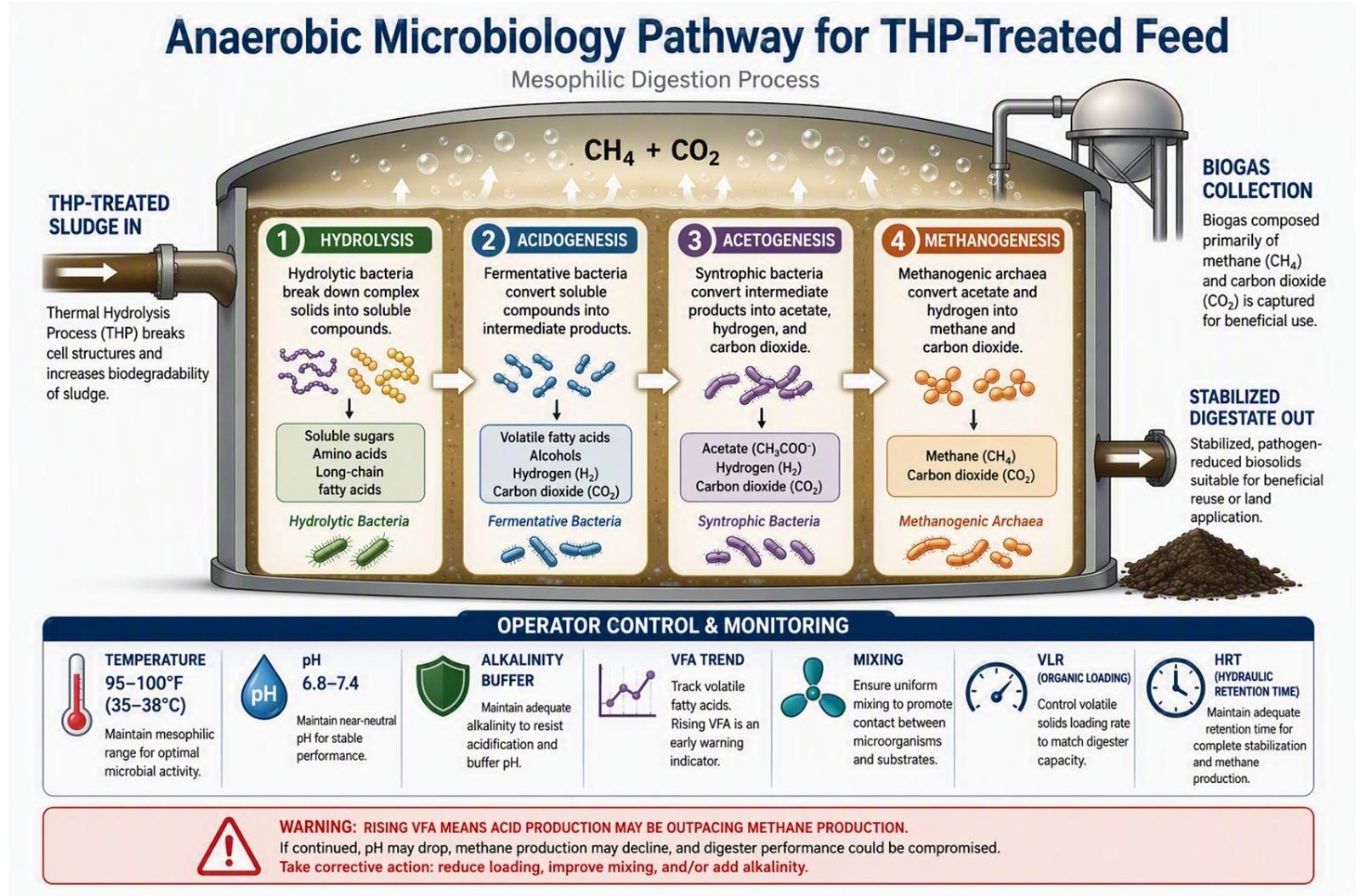
Operations startup and commissioning services support for HRBC, DAF, solids handling, Cambi B6 THP (about 69 dry tons/day), Digester 3, and gas systems. We also wrote the O&M and training manual, the training deck and the THP digester operating workbook, and provided startup plan input and final review. Client: City & County of Honolulu. Startup 9/2026 to 4/2027.
 Hawaii
Plant headworks, primary clarifiers, odor control and plant water
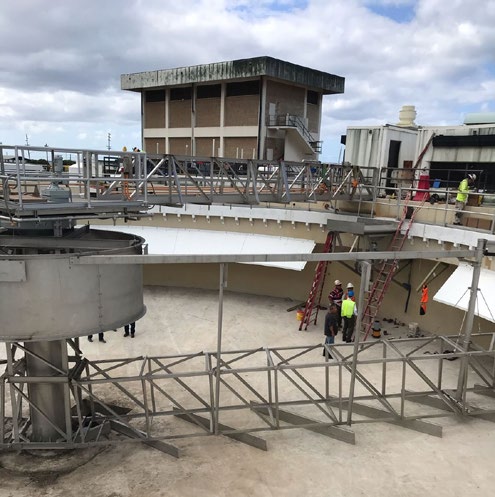
Working as a subcontractor to the contractor, we developed the startup plan and were responsible for the onsite commissioning phases of the headworks, primary clarifiers, odor control and plant water systems. The first project included grit and screening, and the second included a digester.
Operator training engagement
A six-month operator training engagement at a Hawaii wastewater plant.
Joint base effluent pump station
Startup plan input, plus onsite startup and commissioning.
Filters and clarifier at a Marine base
Startup and commissioning of tertiary cloth media filters and a secondary clarifier.
Polishing pond and chlorine contact
Polishing pond and chlorine contact rehabilitation. We provided operational guidance and project delivery direction to the contractor during the project.
National park visitor center waste reuse facility
Optimization of the visitor center waste reuse facility at Haleakala for the National Park Service.
USS Arizona Memorial
Startup service on the unique stacked sequencing batch reactor (SBR) treatment plant, performed under a contract with the National Park Service.
Membrane bioreactor operations in Hawaii
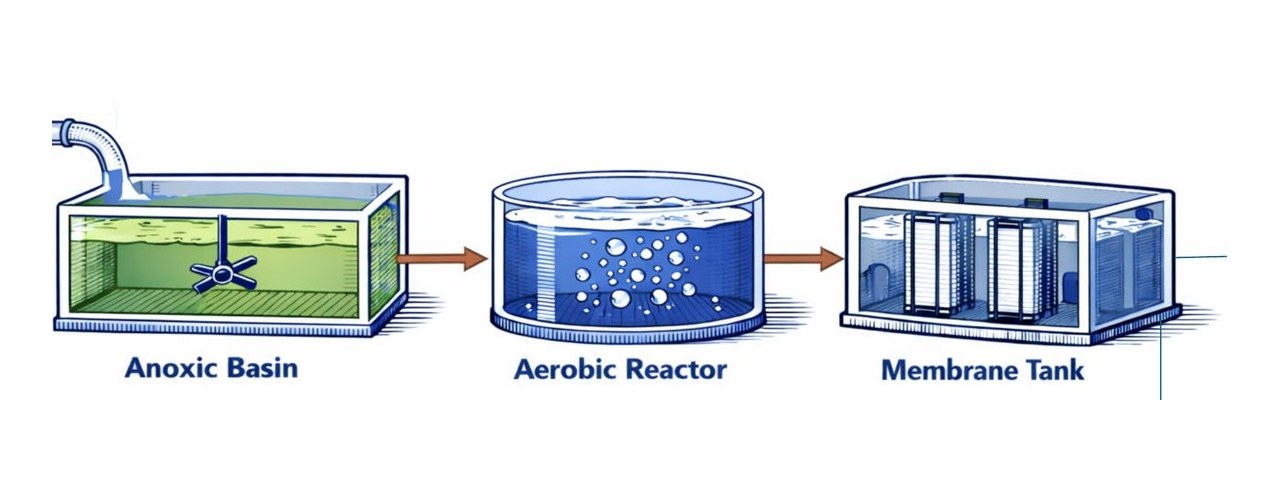
Our operations guidance for a membrane bioreactor (MBR) in Hawaii, in one picture. Primary effluent flows through the anoxic basin and the aerobic reactor to the membrane tank. Return activated sludge (RAS) goes back to the anoxic basin.
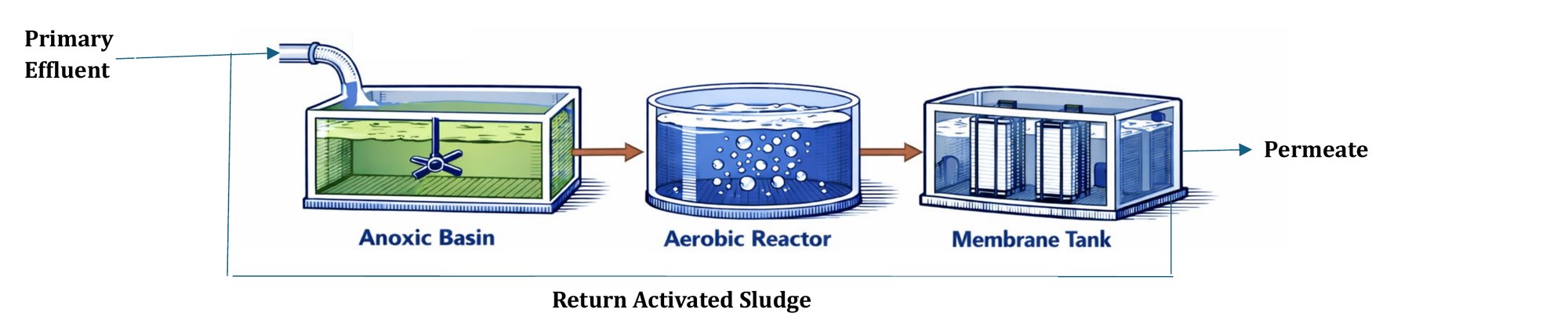
Control of anoxic
- Bacteria use nitrate (NO3) to consume soluble BOD while reducing nitrate to nitrogen gas (N2). The N2 gas goes to the atmosphere.
- Maintain negative ORP (−10 to −100 mV).
- Keep DO at or near zero through proper reactor and membrane DO control.
- Increase RAS rate and/or reduce DO to achieve lower nitrate in the MBR effluent.
- Expect a measurable drop in nitrate from RAS to anoxic discharge.
- The anoxic process lowers overall blower energy in the aeration basin by reducing the BOD load to the reactor.
Control of reactor
- Maintain DO between 1 to 3 mg/L.
- Waste excess biomass (WAS) to maintain target MLSS.
- Remove surface foam as needed.
- MLSS between 7,000 to 9,500 mg/L.
- Oxidation: BOD → CO2 + H2O + energy + more bacteria.
- Nitrification: ammonia → nitrite (NO2) → nitrate (NO3).
- Captured screening material goes to the GBT with WAS sludge as needed.
Control of membrane
- Physically separates treated water from biomass.
- Concentrates high MLSS to reduce WAS volume.
- RAS brings “hungry” bacteria back to the anoxic tank.
- RAS DO should be low to prevent oxygen intrusion into the anoxic zone.
- RAS flow directly affects nitrate removal and WAS concentration to solids handling.
- RAS rate between 3 to 4x Q.
Mainland startups and upgrades
Plant upgrade
Startup plan input and onsite commissioning, plus an O&M manual and operator training.
Plant upgrade
Startup plan input and onsite commissioning, plus an O&M manual and operator training.
Plant: manuals and training
An O&M manual and operator training for a second Indiana plant.
Operations services at two engineering firms
We led startup and commissioning on nearly every major wastewater project at two national engineering firms. The work included vendor training, staff onboarding and post-startup optimization.
Pump stations, headworks and grit
Commissioning of pump stations, headworks and grit removal, as part of that operations services work.
Secondary, filters, clarifiers and digesters
Commissioning of advanced secondary processes, filters, clarifiers, digesters and dewatering, as part of that operations services work.
Optimization and permit compliance
Energy and process audits, troubleshooting and process changes with documented results.
Municipal plant: process and energy audit
$536,550 per year
An energy and process audit cut O&M costs $536,550 per year and added capacity valued at $3,832,000. Effluent BOD went down 57%, TSS down 16.4%, and ammonia down 10%. See the full results.
Indiana plant: energy and labor audit
Over $450,000 per year
An energy and process optimization audit identified potential energy and labor savings of over $450,000 per year.
Resort community SBR plant
SVI from 400 to below 150
We provided support services for an overloaded plant: management and operational assistance, training, design review, laboratory evaluation and maintenance assistance. Driven by regulatory pressure, plant modifications cut SVI from 400 to below 150, so solids stayed in the plant and permit compliance followed.
- Met summer permit limits for the first time in five years
- 17% added capacity, which let the utility delay design and upgrade for eight years, an estimated savings of $500,000
- We also developed startup training for the SBR plant and managed the O&M manual, writing the secondary treatment chapter
 Oregon
City plant process evaluation
TSS from 60 to below 10 mg/L
The plant had been performing poorly and unstably for about a year. Our process changes cut effluent TSS from 60 mg/L to reliably below 10 mg/L, and still dropping. We also reviewed the project during construction for potential improvements.
Activated sludge plant: energy and process audit
Over $200,000 per year
The audit identified energy and chemical savings totaling over $200,000 per year, and its findings helped staff reduce effluent nitrate. We also identified aeration system design issues that were hindering operation.
SCADA system review
In a separate project at the same plant, we reviewed the SCADA system and recommended changes that reduced manual information collection, improved energy monitoring and made the information more useful.
Plant ammonia troubleshooting
Troubleshooting and bench-top toxicity testing for poor ammonia removal. While testing, we offered optimization suggestions that helped the facility regain ammonia permit compliance. Other work for this utility included optimization of the anoxic selector and plant-specific training.
County plant capacity re-rating
A system-wide optimization approach to determine whether the capacity of a county plant could be re-rated. Benefits:
- Increased capacity
- Reduced capital costs
Contract operations reviews
We were part of a team that gave cities comprehensive performance reviews of their contracted wastewater plants, used to decide whether the contracts were being met and renewal was warranted. The reviews covered maintenance, operations, laboratory, finance, asset management, safety, SOPs, manuals, SCADA and more. We also gave input on contract revisions and helped write RFPs and score proposals.
Operator training programs
Plant training from startup training to certification programs. See the classes we teach.
10 mgd plant: operator training and certification
All 12 operators certified
We have trained at this plant for 26 of the last 29 years, with plant-specific programs on activated sludge process control, anaerobic digestion, solids handling, chlorination and dechlorination, and safety. We also wrote the plant O&M manual after its last upgrade.
- When training began, very few of the 12 operators were certified
- After a few years, seven were Class IV and every operator was certified
- The team placed 2nd in the state operator competition, winning the process and safety events
- Benefits: more motivation and professionalism, future leaders and managers, professional growth, and better operational performance with less risk
Regional authority: 150+ mgd
We developed and delivered training for a large activated sludge plant serving a large segment of a major metro area. Over multiple visits, topics included activated sludge process control, biological selectors and biological nutrient removal.
450 mgd plant
We directed the development and delivery of training materials for the Power Restart and Digester Screening facilities. The training covered operations, mechanical maintenance, electrical, instrumentation and HVAC for each piece of equipment in each unit process.
Regional district startup training
We developed startup training materials for the secondary treatment process and provided QA/QC on the training materials for other unit processes, at two regional plants of 120+ mgd and 20 mgd.
44 mgd plant
As part of a team, we evaluated the training and staffing needs at the utility. We developed startup training materials for the activated sludge plant and provided QA/QC on training materials developed for other unit processes.
Phase 1C solids and gas systems
A training deck and a THP digester operating workbook for operators, written with the O&M and training manual.
O&M manuals
Plant-specific and electronic O&M manuals for municipal and industrial plants in Texas, Washington, Oregon, California, Idaho, Indiana, British Columbia and Hawaii.
Water district, city and industrial plants
Plant-specific, detailed and complete O&M manuals for a water district's two plants: a 10 mgd complete mix activated sludge plant with anaerobic digestion, and a 4 mgd plant with primary treatment, biotowers for secondary treatment and chlorine disinfection. Also a city plant and an industrial plant.
Two large city plants
Electronic O&M manuals for a city's two liquid wastewater treatment plants, large and complex facilities with a combined treatment capacity of up to 150 mgd.
Seven plants
Seven plants, one of them for a regional clean water agency.
City and municipal plants
A city plant in California, a city plant in Idaho, and two plants in Indiana, including the 10 mgd plant above.
Industrial plant
An O&M manual for an industrial plant.
Phase 1C and membrane facilities
An O&M and training manual for the Phase 1C solids, DAF, HRBC, THP, digester and gas systems, and O&M manual support for a membrane and solids handling facility.
Talk with us about your plant
Call 503-701-2766 or email info@ActivatedSludge.com.